
The Digital Prompt Book for Stage Managers
Replace binders, sticky notes, and pencil marks with a searchable, shareable, and exportable digital prompt book built for professional theatre.
What Is a Digital Prompt Book?
A prompt book is the stage manager's master document — the annotated script that contains every cue, blocking note, and production detail needed to run a show. Traditionally, this is a physical binder with a printed script, hand-written cue notations, blocking diagrams drawn in pencil, and pages of production notes held together with tabs and sticky notes.
The most widely used prompt book method is numbered blocking notation — circled numbers in the script at each blocking moment, with corresponding numbered notes on the facing page. This facing-page system keeps the script readable while allowing detailed blocking records. Lines and arrows on the script page show movement direction, while the opposite page holds the full description.
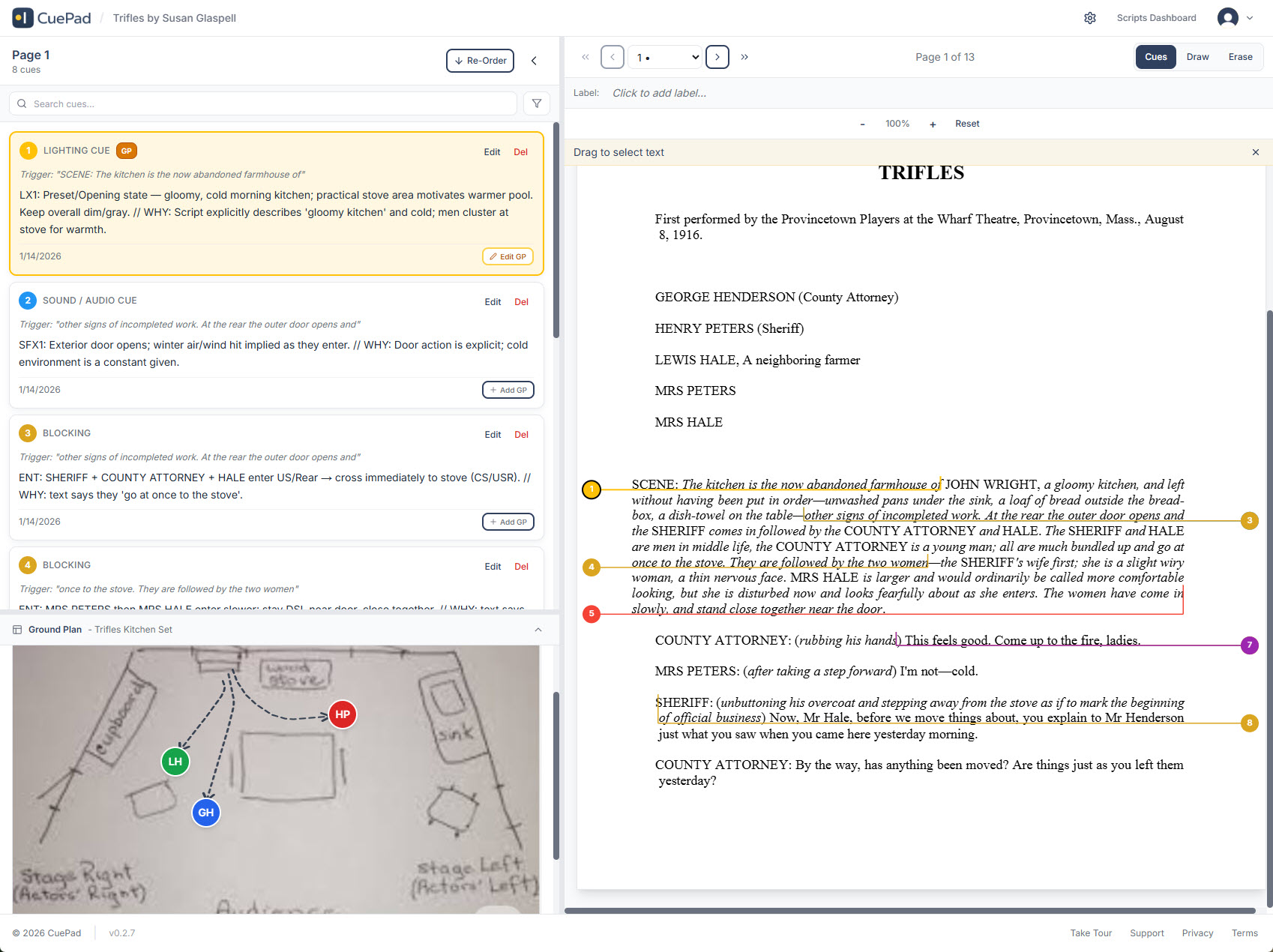
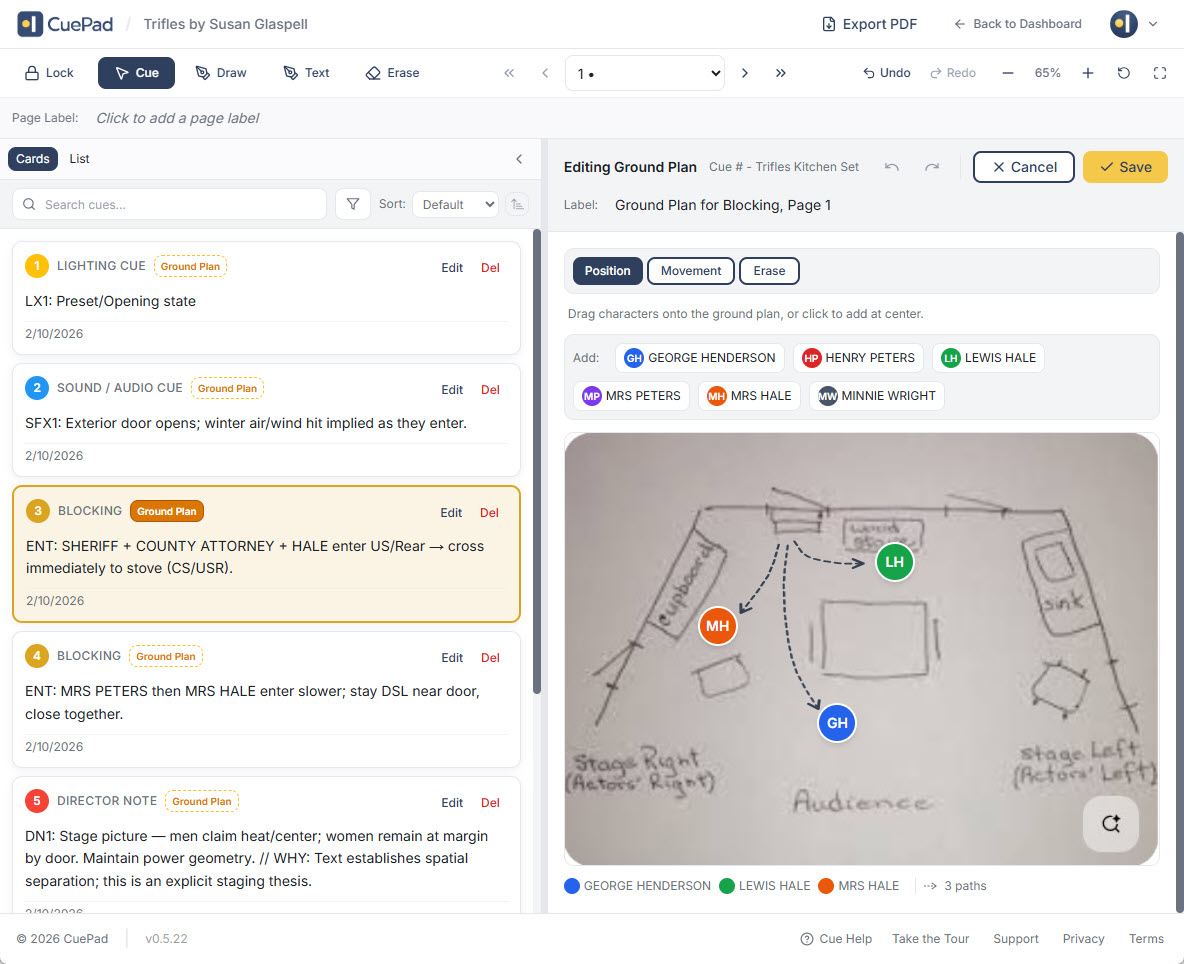
A digital prompt book brings this same workflow into a single application. Instead of writing circled cue numbers in the margins, you select trigger text and attach typed, indexed cues directly to the script. Instead of sketching blocking diagrams on the facing page by hand, you place character markers on uploaded stage diagrams. Instead of photocopying your book for the production team, you share a link. The core workflow — script anchor to blocking entry — remains exactly the same.
The result is a prompt book that's searchable, backed up automatically, and always legible — whether you're calling a show from the booth or reviewing notes on your tablet during a production meeting.
Why Paper Prompt Books Fail
Paper prompt books have served stage managers for decades, but they come with serious limitations that digital tools can solve:
- Handwritten cues become illegible under pressure or after multiple revisions
- Paper ground plans can't be updated without redrawing the entire diagram
- There's no backup — if the binder is lost or damaged, the work is gone
- Sharing requires photocopying, and copies immediately become outdated
- Searching for a specific cue means flipping through every page manually
- Reorganizing cue numbering after insertions or deletions is tedious and error-prone
What a Modern Prompt Book Includes
A complete digital prompt book goes beyond simple PDF annotation. It should include everything a stage manager needs to prep and run a show:
- Indexed, color-coded cues attached directly to trigger text in the script
- Ground plan diagrams with character positions and movement paths
- Freeform highlights and drawing annotations on script pages
- Typed text boxes for notes, reminders, and production details
- A searchable cue list for reviewing all cues at a glance
- PDF export to produce a print-ready prompt book document
How CuePad Works
CuePad is a digital prompt book application designed specifically for stage managers, directors, and production teams. Upload any script as a PDF, then annotate it with cues, blocking, highlights, and notes — all synced to the cloud.
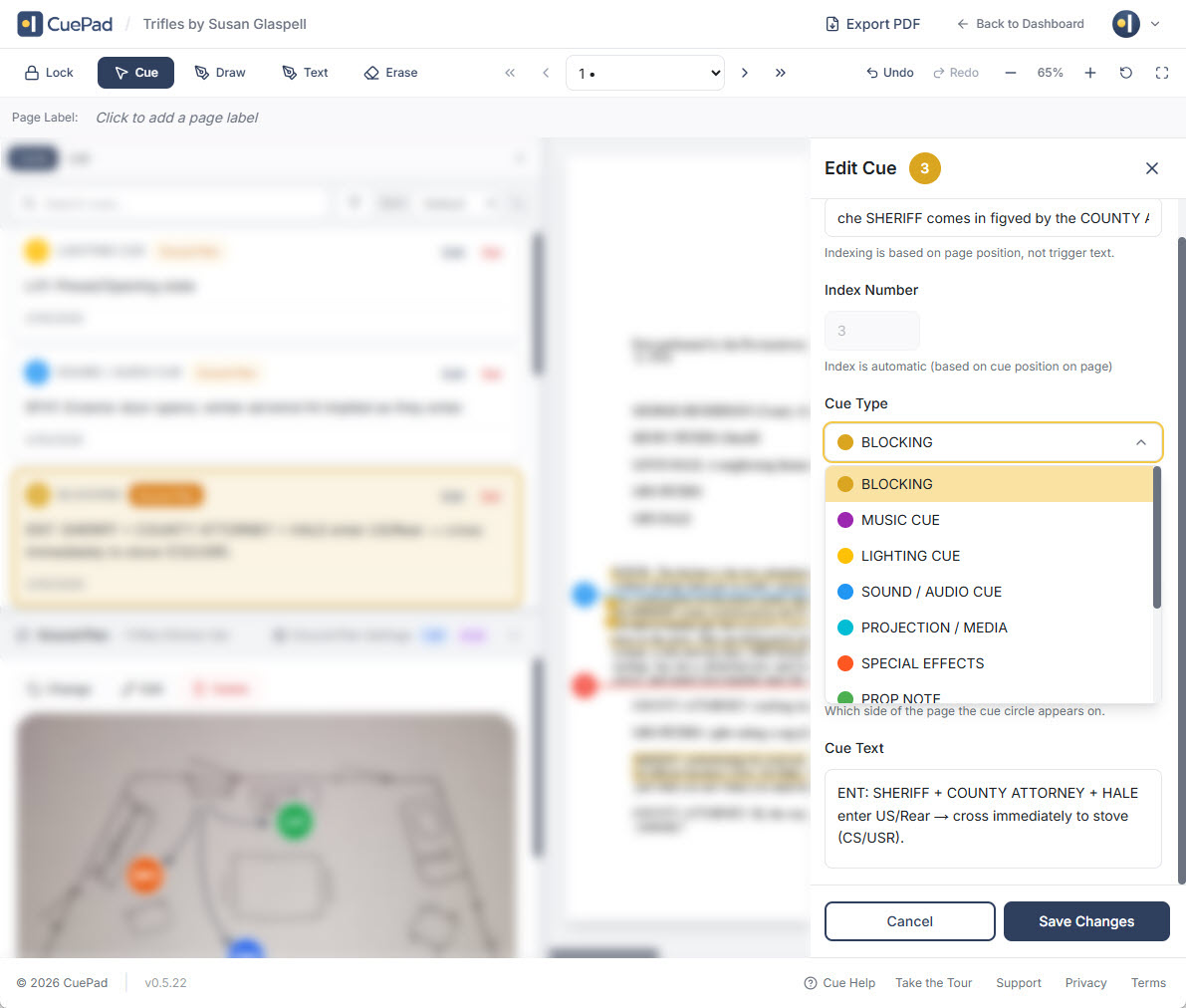
Create cues by selecting trigger text directly on the script. Each cue is automatically indexed, color-coded by type (Blocking, Lighting, Sound, Music, Projection, Props, Costume, Scenic, Director), and connected to its trigger with a visual connector line.
Upload ground plan images and place character markers to record blocking. Draw movement paths, assign ground plans to cues, and export everything as a professional prompt book PDF ready for rehearsal or archiving.
Digital vs. Paper Prompt Book — A Direct Comparison
The paper prompt book has been the standard for over a century, and it works. The question isn't whether paper works — it's whether digital does the same job better. Here's how the two approaches compare across the things that matter most in production.
| Paper Prompt Book | CuePad Digital Prompt Book | |
|---|---|---|
| Setup time | Hours of printing, cutting, and organizing | Minutes — upload PDF and start |
| Cue legibility | Depends on handwriting; degrades with revisions | Always typed and indexed |
| Blocking diagrams | Hand-drawn; must be redrawn when blocking changes | Interactive; update positions on ground plan |
| Backup | None — if the binder is lost, the work is gone | Automatic cloud backup |
| Sharing | Photocopy and distribute; copies go stale | Share a link; everyone sees the same version |
| Search | Manual — flip through every page | Instant full-text search across all cues |
| Revision | Cross out and rewrite; messy under pressure | Edit in place; version history saved automatically |
Who Uses a Digital Prompt Book?
Digital prompt books are used across all levels of professional theatre. Stage managers at LORT theatres, regional companies, and community productions use them to manage increasingly complex shows with smaller staff. Directors use them in pre-production to pre-block scenes before the cast arrives. Assistant stage managers use them to track notes without juggling a second binder.
Theatre educators are increasingly moving to digital prompt books for student productions — they're easier to share with faculty supervisors, preserve across multiple student stage managers, and provide a professional workflow for students learning the craft.
For productions with long runs — touring shows, stock productions, or shows that will be remounted — a digital prompt book is a permanent record that can be handed off cleanly. No deciphering handwriting. No missing pages.
Start Free with CuePad
Upload your first script and build your digital prompt book in minutes. No credit card required.
Start Free with CuePad